


Sie möchten die Tour lieber auf Deutsch erleben? Klicken Sie hier.
HORTUS Fact #3 – Made on Main Campus
The Clay-Timber Ceiling & the Field Factory
Although clay and timber are among humanity’s oldest building materials, clay in particular has long held only marginal importance as a construction material. Accordingly, industrial manufacturing processes for clay elements are scarcely developed. For the HORTUS it was therefore necessary to establish a production method that was both resource-efficient and effective, as well as to determine a suitable location. Because transporting the clay and timber required for the ceiling elements would also generate emissions, the decision was made to build an innovative “field factory” directly adjacent to the construction site.
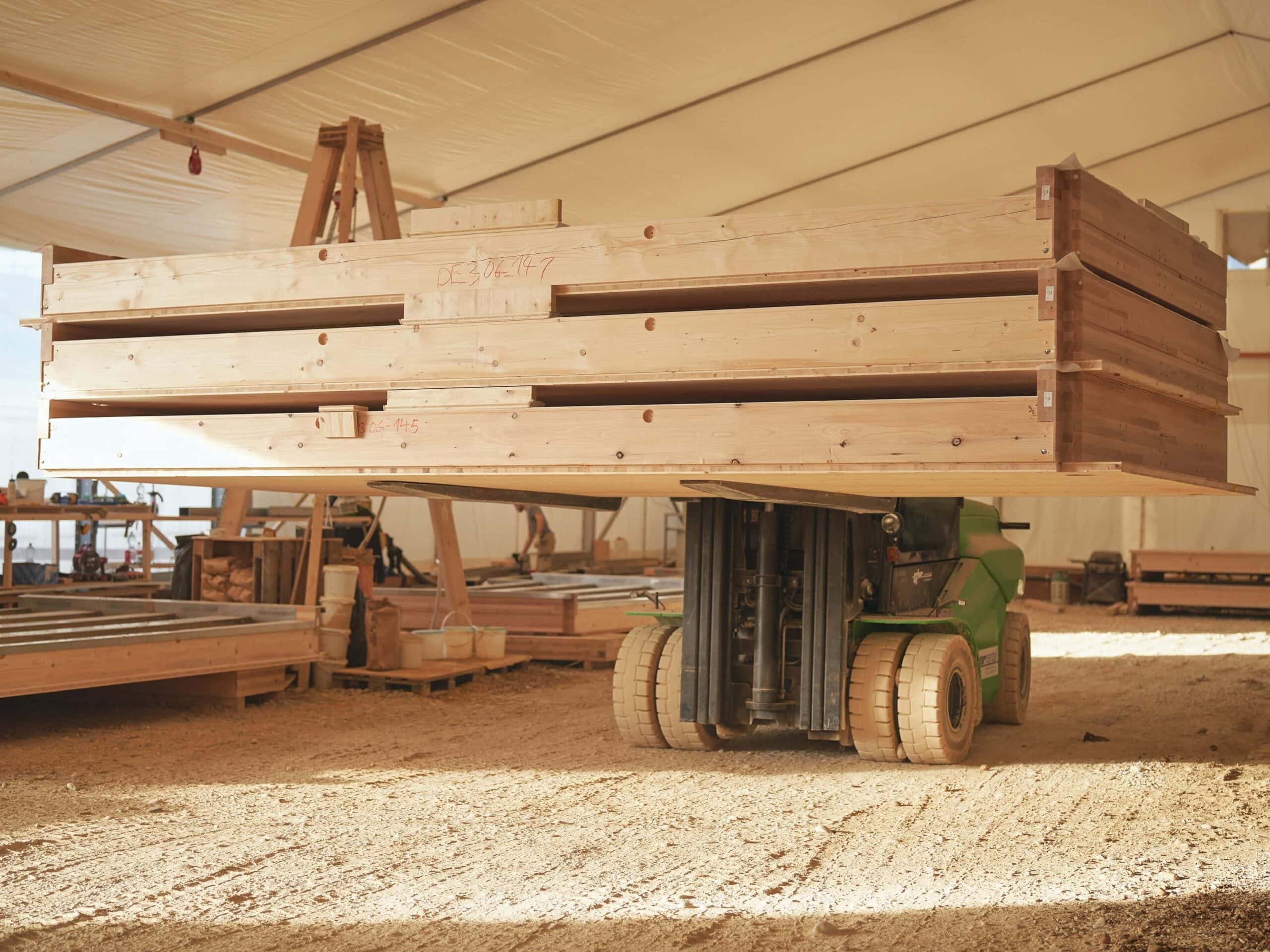
The field factory consisted of five tents: A mixing tent, a production tent, a storage tent, and two buffer tents. Timber specialists Blumer Lehmann, together with the Austrian clay experts from Lehm Ton Erde, developed the entire field factory in just three months. A custom machine was created specifically for the logistics of the rammed clay mixture. The stamping stations were specially designed to fill the prefabricated timber elements with rammed clay as efficiently as possible. The team responsible for the field factory consisted of ten people in total.
Manual processes: Because the field factory was developed from scratch, not all steps could be automated. The focus was on material logistics, as nearly 30 tons of rammed clay mixture had to be loaded daily into the prefabricated timber elements. While various machines eased the tamping and compaction process, much manual labor was required for the many steps—from excavation to the fully tamped element. Overall, 75% of the clay came from the site itself, with the remainder sourced locally as marl.
Each of the 800+ ceiling elements weighs 3.5 tons. They all are designed as a fully demountable module, connected with mechanical fasteners instead of glue. This ensures they can be dismantled, reused, or recycled at the end of their service life. The rammed earth infill improves acoustic comfort, regulates humidity, and adds fire resistance. This circular, hyper-local approach to construction blurs the line between manufacturing and building, setting a precedent for how architecture can integrate production into the site itself—reducing waste, cost, and environmental impact while boosting craftsmanship.
You can find the next QR code here: